What to include on a custom furniture quote
Write the fabric, finish, size, timing, delivery, and payment details so the customer and the next member of staff can understand the same purchase.
The OrderPilot team·
The vendor’s email arrives after the sale: “Which gray? Which arm? Which leg finish?” The quote reads, “Sofa, custom, gray, twelve weeks, $4,200.” The customer remembers darker legs. The associate is off until Thursday. Everyone has a piece of the answer; nobody has a complete specification.
A custom furniture quote should identify the purchase well enough that the customer, purchasing, receiving, and service can recognize the same piece. Record exact options, a complete price, timing, the way home, and the terms. Then state what the customer needs to do next. A quote starts as a selling document and becomes the reference for the work that follows.
Identify the piece beyond its showroom name
Include the model, quantity, size, and orientation where relevant. For made-to-measure pieces, use the vendor’s permitted dimensions and units. A room note saying “shorter version” cannot replace the size the maker needs to produce.
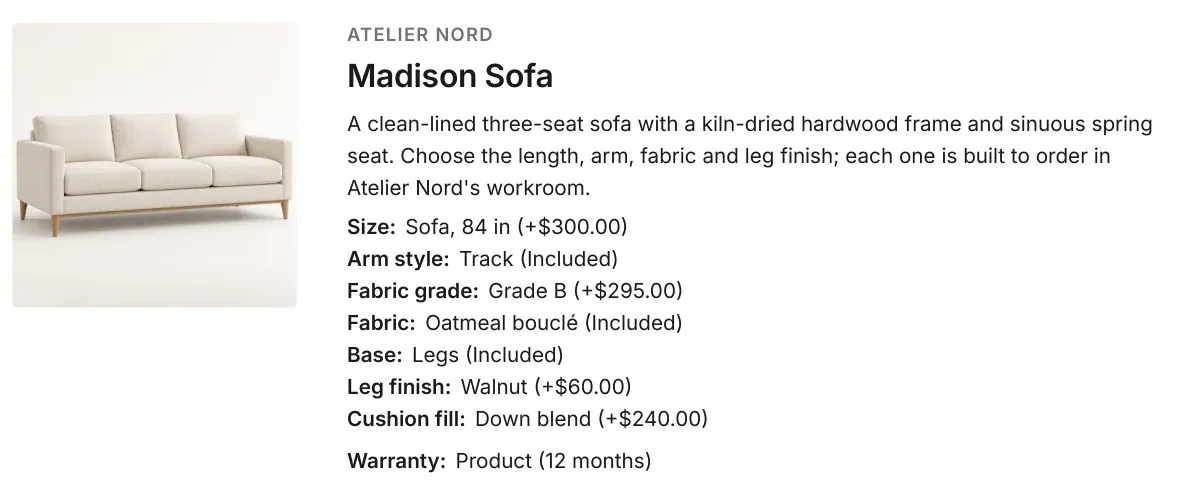
Name every selected option with the vendor’s label or code: fabric and grade, finish, leg, arm, cushion fill, trim, and any other choice required for that product. Keep the terminology consistent between the sample, template, and quote. “The darker one” is a perfectly useful phrase while pointing; it has a short working life on paper.
Use swatch and product images to support the words. Explain when a product photograph differs from the selected configuration. A picture can show the model beautifully while displaying the wrong upholstery or base. The written choices should leave no doubt about which version is being offered.
For a product that needs a fuller technical description, share the product spec sheet alongside the quote. It complements the sale record rather than replacing the agreed price and terms.
Make a provisional COM choice visibly provisional
Customer’s own material needs the maker’s approval and requirements before a final order can proceed. Record the intended fabric reference, the party supplying it, the maker’s confirmed yardage or quantity requirement, and the shipping instructions for the material. Pattern repeat, direction, and other material details belong in that review where the maker requires them.
If the customer has not bought the fabric, quote only what is actually known. Identify the COM allowance or upholstery charge separately from any fabric the customer purchases elsewhere, and list what still awaits approval. Do not present an unapproved material as a settled fabric choice simply because the customer likes it.
Give the outstanding task an owner. Someone must obtain the maker’s acceptance and final material requirements before committing the configuration. Once that information is settled, revise the quote so the customer reviews the actual purchase, including any effect on price or timing.
Show the complete price and named adjustments
The customer needs to see what the piece costs with the selected options, plus the charges required for the agreed purchase. Make an option’s price effect understandable. Show a discount as a discount rather than burying it in a new description of the product.
Delivery, assembly, removal services, and design time should have names that explain the work. A fee labeled “Other” leaves the next associate to remember whether it covered a stair carry or a fabric upgrade. Keep service products, delivery charges, and any warranty plan distinguishable on the quote.
The customer-facing quote should show retail prices and agreed adjustments, not the vendor’s cost or the store’s markup. Those internal figures belong in the staff views permitted by the store’s roles. A purchase order serves a different audience and carries the vendor’s commercial details.
State the tax treatment shown for this transaction. For a trade purchase, a claimed exemption needs the required documentation and correct setup; a customer’s business name alone is not the explanation. The customer should be able to identify the full amount they are being asked to accept.
Use a worked quote to expose missing choices
Here is an illustrative order before tax, using fictional sample product information. These numbers demonstrate the structure, not a real vendor offer.
| Item or charge | Agreed detail | Amount |
|---|---|---|
| Madison sofa | 88-inch size, track arms, standard cushion fill | $3,600 |
| Selected upholstery | Grade C performance linen, fabric reference C-120, color Pebble | $400 |
| Selected legs | Walnut taper legs | $200 |
| Sofa discount | Approved fixed discount, recorded with its reason | −$200 |
| Stocked lamp | Selected model and finish; customer takes it today | $300 |
| White-glove delivery | Sofa to the agreed room; unpacking and packaging removal included | $250 |
| Design consultation | Agreed service scope | $100 |
| Subtotal before tax | $4,650 |
The sofa totals $4,200 before its discount and $4,000 after it. The mixed purchase totals $4,650 before tax. The quote should also explain the required deposit, balance timing, access conditions, and current delivery estimate; the price table does not answer those questions by itself.
The lamp does not need a separate quote just because it goes home sooner. OrderPilot can mix regular Shopify products, configured furniture, and service products, with the physical items’ handover choices recorded separately. Make clear which pieces are taken now and which remain to be delivered.
Write timing as information the customer can use
State an estimated date or range and explain its basis. Distinguish production from transport, receiving, and the store’s delivery arrangements. If the selected fabric changes the estimate, say so rather than quoting the timing for the model’s quickest configuration.
In OrderPilot, option lead time appears on the template and Admin order line; it does not automatically print on the quote PDF or PO. Include the timing explanation deliberately in customer-facing written information, and make sure the contract documentation contains the information your sale requires. The lead-times-by-option guide explains the product side.
For covered New York sales, General Business Law §396-u(2)(a) requires an estimated delivery date or range on the customer’s contract copy, but §396-u(1)(c) expressly excludes substantially custom-made or custom-finished furniture from its definition.
If the estimate changes after the quote is sent, tell the customer which item is affected and what the revised expectation is before proceeding. If the order is already placed, keep the update with the order and follow the store’s agreed process. Silence does not preserve the original estimate.
Describe the delivery the customer is buying
Use a service name and enough detail to explain the scope. “White glove” alone does not establish whether assembly, stairs, packaging removal, or old-furniture removal is included. Record the agreed work and any access information the delivery team still needs.
Separate delivery arrangements from the product’s source. A sofa ordered fresh can be delivered or collected when ready; a stocked lamp can go home today. The quote should not suggest that every item will arrive together unless that is the arrangement the store has agreed to provide.
If a stair carry or other charge remains subject to access review, resolve it before presenting a final total for acceptance. A provisional offer can keep the conversation moving, but its unresolved work should be visible to the customer and the staff who continue it.
Put the terms beside the decision
State the deposit amount or method, when the balance is due, and the terms governing changes and cancellation. Include product-specific matters such as natural material variation, COM responsibilities, or a floor piece’s agreed condition where they belong to the sale.
OrderPilot can include category and product terms on the quote and signing page, and the signed record preserves the agreed terms. The product-terms guide explains how that information stays with the agreement. Review the actual terms presented, rather than assuming a standard footer covers every special case.
The printed Valid until date normally runs thirty days from the quote’s creation. Resending does not reset it, and the period is not a standard merchant-editable control. Review an older quote’s date and offer before sending it again; the quote-validity guide covers that decision.
Build the selected version in OrderPilot
Start with the product template and select the required options. The template holds the option labels, images, and pricing; the Admin order line gives staff the lead-time information to communicate. The resulting quote should describe the configuration just selected, not the floor model by default. Add the agreed line discount, named delivery fee, and service products. Confirm the handover choices for physical pieces. If payment is being requested, use the supported route for the Shopify plan: enabled deposit orders work on quotes and drafts across plans, while native percentage deposits and POS Take Deposit require Shopify Plus. Review the branded PDF. Merchants control the brand information, business and bank details, terms, salespeople, and reference; broader design controls such as fonts and columns require staff-enabled access. Use those available fields to make a quote that looks like the showroom and contains the correct purchase.
Run the pre-send check from the customer’s side
- The correct customer, contact details, and project reference are present.
- Every physical piece has the right model, quantity, size, and orientation.
- Fabric, finish, legs, arms, and other options use exact names or codes.
- COM or other unresolved specifications are identified and assigned.
- Images agree with the selection or clearly explain any difference.
- Prices and option changes produce the intended total.
- Discounts, named fees, services, and protection charges are clear.
- Tax or the supported exemption is reflected correctly.
- Written timing identifies the estimate and its basis.
- Delivery or pickup and the service scope are clear for each piece.
- Payment, change, cancellation, and product terms match the offer.
- The validity information and the requested next action are correct.
Then read the document as someone who was not in the showroom. The useful next action might be to answer a remaining question, sign, or pay the agreed deposit; name it. Continue with the be-back playbook when the customer needs to finish the decision at home.
Sources
- New York General Business Law §396-u — New York State Senate, statutory revision September 22, 2014; §2(a) delivery disclosure and §1(c) custom-furniture exclusion.
- OrderPilot product truth, approved Features scope, app feature audit, and product answers — supplied internal product references for the quote, documents, payments, and printed validity behavior.
Read the quote as someone who was not in the showroom.













