Custom dimensions within allowed ranges: tables cut to length, rugs to size
Capture the size the vendor can build, use the right pricing model, and keep the agreed measurements with the order.
The OrderPilot team·
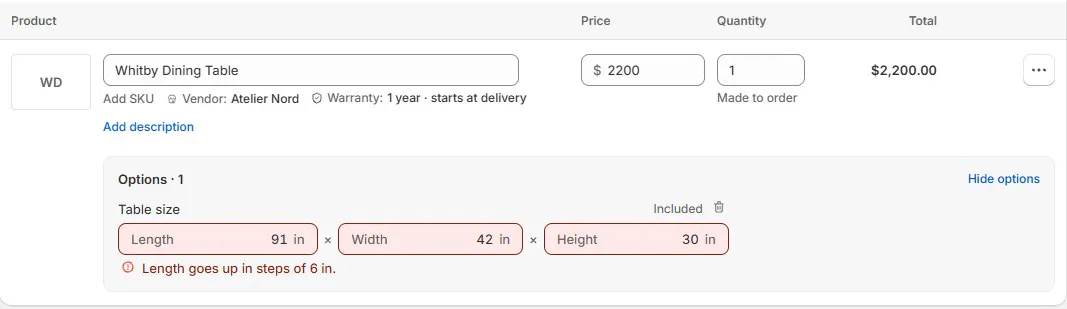
“Can you make it 91 inches?” In this example, the vendor builds the table from 72 to 120 inches in 6-inch steps. The associate says yes, the PO says 91, and the acknowledgment comes back at 90. An inch is a small thing to leave in charge of the conversation.
Custom dimensions need explicit ranges, steps, and units before the customer chooses a size. In OrderPilot, use Dimensions to capture a measured specification, Number for a quantity priced per unit, and priced size choices when the vendor sells fixed tiers. Each model answers a different pricing question.
Which size option matches the vendor's book?
Choose the option type according to how the maker accepts and prices sizes. A product template can carry the specification without treating every measurement as an ordinary size label.
| Model | Best fit | Pricing behavior |
|---|---|---|
| Dimensions | Length × Width, or Length × Width × Height | A flat charge when a size is entered |
| Number | One measurement or chargeable quantity | Price per entered unit |
| Dropdown size tiers | A defined list of buildable sizes | A price for each offered choice |
A Dimensions option gives each part its own range and step, with one unit for the whole option. Values are checked on the desk, POS, website, and save. Dimensions don't calculate area or track stock; use the measured specification alongside the pricing model that matches the job.
Can the price change automatically with size?
A Number option multiplies its entered quantity by its per-unit price. A Dimensions option charges its flat amount; it doesn't multiply length by width for you. For a rug sold by area, staff can calculate the chargeable area and enter it in a clearly labeled Number option, or use priced size tiers.
Say an illustrative rug is 6 × 8 feet, priced at $20 per square foot with a 30-square-foot minimum. Its area is 48 square feet, so the price is $960. A 4 × 5-foot request has only 20 square feet: whether the maker rejects that size or bills a minimum is a separate policy. Configure the offered sizes and chargeable quantity accordingly.
A rug maker's custom-size FAQ illustrates why minimum-area policies belong in setup. Read your own maker's rule rather than copying another range. The fuller custom-rug quoting guide covers minimums and the customer's agreement.
If a table has an included length plus a charge per extra inch, record the finished length separately from chargeable extra inches. Staff calculate the excess and enter that Number quantity; don't describe it as an automatic subtraction formula. Priced tiers are clearer when the vendor already supplies them.
Will the exact size reach the customer and vendor?
The dimension value travels with the configured line and its manufacturing options. In the table example, the printed specification can read “96 × 42 × 30 in” on the customer document and vendor PO. Review the output so everyone interprets the part order the same way.
Pair written measurements with a labeled diagram. Baymard's 2024 furniture research found that participants struggled to connect text measurements to the product parts they described. Your measuring guide should explain both the piece and its route into the room; diagonal depth matters for upholstered pieces too.
What happens when the customer requests another size?
Put the maker's stated tolerance and size conditions in the template's additional terms before signing. The signed terms are frozen with the agreement. Use the maker's actual wording and tolerance rather than inventing a universal allowance for custom work.
The customer can request a size change through the portal, with the parts checked against their ranges. Staff review Current versus Asked in the Inbox and decide whether the requested change can be fulfilled. A customer-facing change requires a new signature.
What belongs in the setup check?
Record the vendor's minimum and maximum, permitted increments, measurement unit, part names, tolerance, pricing method, and any minimum charge. Test a boundary value and a value between allowed steps. Then compare the quote and PO with the intended specification.
Keep those facts in the catalog alongside the other essential custom-product fields, so the next associate can answer the size question while the customer is still beside the table.
Sources
- Custom Sized Rugs FAQs — STARK. Vendor policy example for minimum area and custom sizing.
- Always provide a dimensions image — Baymard Institute, October 15, 2024. Original usability research on matching measurements to product parts.
The finished size and the chargeable quantity need to mean exactly what their labels say.













