Pricing custom furniture: keystone, multipliers, and landed-cost margin
Choose a selling-price method, give every option a cost, and measure the result against what the piece costs to reach your store.
The OrderPilot team·

Say a sofa's factory price is $2,000 and the store doubles it to $4,000. In this illustrative shipment, freight and other acquisition charges bring the landed cost to $2,800. The product margin is now 30%, not the 50% suggested by the factory-price calculation.
Choose the selling-price method deliberately, then test it against the complete cost of the configured piece. OrderPilot keeps option prices and costs separate and supports landed-cost allocation when goods arrive. The useful result is a margin based on the furniture you actually bought, including its selected fabric and finish.
What do keystone and other multipliers mean?
Keystone means setting retail at twice wholesale cost, as described in Shopify's pricing guide. It is a calculation method, not evidence that the resulting price will suit your customers or cover your store's operating expenses.
A category multiplier applies the same idea with a chosen factor. The owner might use different factors for different kinds of product, but those are store decisions rather than universal furniture benchmarks. State the cost base alongside the factor: factory invoice, delivered vendor cost, or a properly assembled landed-cost estimate.
Vendor suggested retail provides another reference point. Treat it as an input to the store's pricing decision, with the vendor's advertising policy considered separately. Minimum advertised price concerns advertised pricing; it doesn't tell you the product's landed cost or establish the margin you will earn.
| Pricing approach | Useful question | Check before relying on it |
|---|---|---|
| Keystone | What does twice the chosen cost produce? | Does the cost include the charges the store bears? |
| Category multiplier | Does this category need a different pricing approach? | Is the factor a deliberate store policy? |
| Suggested retail | How does the vendor position the product? | Does the price work with this store's actual cost? |
| Target gross margin | What price supports the selected product margin? | Is the target sensible for the store and the market? |
Round the final price only after understanding the calculation. A preferred price point changes the margin slightly, so recalculate against that actual selling price. Don't leave the original formula's margin beside a manually rounded amount.
How do margin and markup differ?
Margin compares the difference between selling price and cost with selling price. Markup compares the same difference with cost. Using the opening example's $4,000 selling price and $2,800 landed cost, the difference is $1,200.
The gross margin is $1,200 ÷ $4,000 = 30%. The markup on landed cost is $1,200 ÷ $2,800, or about 42.9%. These figures describe the same example from different bases. Calling them interchangeable makes a target pricing instruction ambiguous.
Gross margin is also different from net profit. Rent, wages, marketing, and other operating expenses still need to be covered. Keep the product-cost calculation clear before comparing it with furniture margin benchmarks, whose definitions and reporting periods may differ.
What belongs in landed cost?
Landed cost includes the product and the costs needed to bring it to the chosen destination. The U.S. International Trade Administration's landed-cost explanation includes freight, insurance, tariffs, taxes, and other fees alongside the product price. For the store's records, use the actual charges and the accounting treatment appropriate to each cost.
Don't calculate duty from an assumed universal percentage or base. Obtain the amount and classification basis from the shipment's documentation and broker. A vendor surcharge and a customs duty are also different items; identify what is included in the vendor invoice before adding another charge.
Here is the opening sofa example expanded into invented per-unit amounts:
| Cost component | Illustrative allocated amount |
|---|---|
| Factory invoice | $2,000 |
| Freight | $400 |
| Duty | $250 |
| Insurance, broker, and onward transport | $150 |
| Total landed cost | $2,800 |
At $4,000 retail, that produces $1,200 gross profit before operating expenses. If the store instead chooses a 40% gross-margin target on the same cost, the calculation is $2,800 ÷ (1 − 0.40), or $4,666.67 before rounding. The target is an example, not a recommendation for every store.
The landed-cost guide follows the component charges in more detail. The practical discipline is to use a consistent destination and cost definition so two products' margins can be meaningfully compared.
Should freight and duty be marked up or passed through?
Decide how the store wants to recover its costs, then test the final combined margin. Passing a charge through at cost can leave the merchandise margin unchanged in dollars while reducing the margin percentage on the full sale. Applying a multiplier to landed cost produces a different customer price.
For a comparison, sell merchandise costing $2,000 for $4,000 and pass through $800 of acquisition charges at cost. Total revenue is $4,800, total cost is $2,800, and gross profit is $2,000, or about 41.7% of revenue. Doubling the full $2,800 instead produces $5,600 revenue and a 50% product margin before operating expenses.
Neither arithmetic result settles the commercial choice. Consider the customer's total, the vendor's pricing policy, the store's costs, and how any separately stated charge will be explained. Use the actual invoice treatment consistently rather than switching bases to make one margin display look better.
Do option additions need their own costs?
Every priced configuration needs the costs of its selected options, including choices the store presents as included. Walnut legs cost the store $90 more but add nothing to the customer's price. The option still contributes $90 to cost and reduces the margin compared with the standard legs.
Give fabric grades, cushion upgrades, finishes, and other options separate price and cost contributions. The owner can decide whether an option uses the same multiplier as the frame. The catalog should record that decision rather than assuming every retail addition implies the same vendor cost.
Use the product-template model to keep shared values and frame-specific exceptions straight. A price on the shared option and an override on one frame should resolve to the intended contribution, not become duplicate charges.
Where does OrderPilot show the cost picture?
The template's Pricing card puts base selling price, base cost, and margin together for staff allowed to view costs. Option values carry their own amounts. Cost history provides a view of stock costs once goods have arrived, so the catalog estimate can be compared with received-cost information.
At receiving, OrderPilot allocates charges such as freight, duty, and brokerage by value, quantity, or a manual amount. Choose the basis that fits the charge and review the line allocations. A single allocation method isn't automatically appropriate for every mix of furniture on the PO.
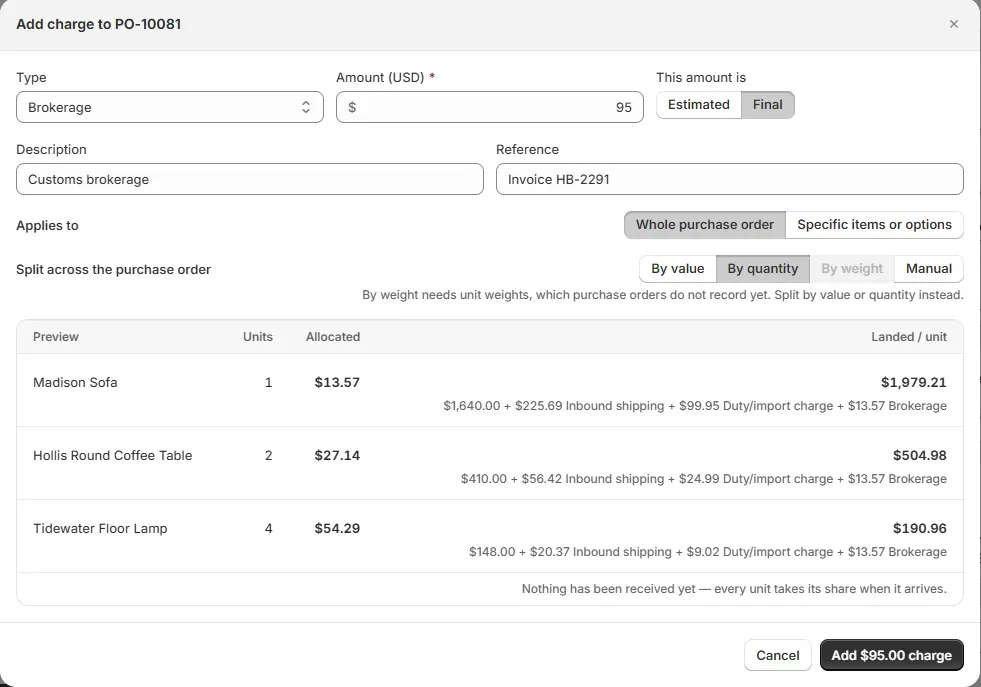
OrderPilot supports FIFO, LIFO, or moving weighted average costing and keeps Shopify Cost per item updated through its costing flow. The order-margin guide explains why the figure after receiving can differ from the estimate used while quoting.
Who should see costs and margins?
Give cost visibility to the people whose decisions require it. Catalog owners need to maintain costs, buyers need to reconcile them, and managers need to evaluate exceptions. OrderPilot's roles control cost access, and supplier costs never appear on the POS register.
Sales associates still need a clear pricing policy even when they don't see cost. Explain which discounts they can offer and when a manager must review the request. The guide to salespeople and furniture cost considers that choice without assuming every showroom should use the same permissions.
What if the freight invoice arrives after the goods?
Keep the recorded cost identified as provisional in your review process while a known invoice remains outstanding. When the actual charge arrives, reconcile it with the estimate and use the supported cost-adjustment or receipt-correction process. Preserve the reason and source document so accounting can follow the change.
Don't simply raise today's template cost and assume that corrects every earlier receipt. Catalog defaults, received stock costs, and customer selling prices have different purposes. Review the affected stock and order margin after the correction, with accounting handling any period-specific consequences.
Give the outstanding-invoice list an owner. It may be the least photogenic object in the showroom, but it should be easy to find. Revisit the catalog after a vendor, freight, or duty change, then compare estimates with completed receipts on a recurring schedule.
Keep this formula beside that review: gross margin = (net selling price − recorded product cost) ÷ net selling price. Use the same cost definition consistently, and start with the landed-cost guide when the components still need separating.
Sources
- Determine total export price — U.S. International Trade Administration. Defines landed-cost components and the need to establish the charge basis.
- How to calculate wholesale product pricing — Shopify, March 17, 2026. Explains pricing methods including keystone.
A multiplier is only as useful as the cost you apply it to.













