A fabric is discontinued: retiring the option across your catalog
Withdraw the current choice at its source, then review the drafts, quotes, and purchase orders that still carry the original specification.
The OrderPilot team·

Picture a customer choosing a sofa and three coordinating pillow fabrics, then hearing the next morning that those fabrics have been discontinued. The correction begins too late. The mill's notice needed a catalog owner before the customer needed a replacement palette.
Retire the choice at its shared source, then review unfinished business separately. OrderPilot preserves placed orders' as-sold wording and prices; removing today's choice doesn't erase yesterday's agreement. That distinction lets the catalog stop offering the fabric while staff resolve the orders that still depend on it.
Should you hide the value, delete it, or archive the option?
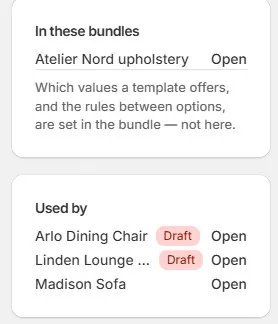
Choose according to whether the withdrawal is temporary, permanent, or applies to the whole option. Open the fabric option's In these bundles and Used by panels to see its catalog reach. Those panels identify usage in the catalog; they aren't a verified search for every open order containing the fabric.
| Action | When it fits | What needs attention |
|---|---|---|
| Untick the value in a bundle | The fabric might return, or only this assortment changes | Following templates inherit the hidden value; locked contributions need review |
| Delete the value from the option | The choice is permanently being removed | Its per-template price, cost, and lead-time overrides are also removed |
| Archive the whole option | The entire option or collection is being retired | Archiving is reversible; review the templates that used it |
Use a shared withdrawal deliberately. Deleting overrides is irreversible, so unticking is usually the clearer choice when availability is unresolved. The bundle guide explains following, local exceptions, and locked contributions.
How do you stop another associate offering it?
Let the catalog change complete its synchronization, then test a fresh configuration at the desk, on POS, and online where used. Inspect locked templates and local overrides rather than assuming every frame follows the bundle. The product-template guide explains where those exceptions live.
Pull the physical swatch from the current selling rail too. A retired sample left between two available linens is still making a fairly persuasive offer. Keep it in a clearly separate reference collection if service or earlier orders still need it.
Tell the floor which fabric changed, which frames are affected, and who owns the replacement discussion. Give associates checked alternatives, with their actual price and timing, so they don't replace one unverified choice with another.
What happens to drafts and unsigned quotes?
Draft work holding a value the template no longer offers can open flagged, with Create waiting for a valid choice. Resolve the fabric with the customer rather than clearing the warning by choosing the nearest name. The stale-options guide covers that recovery in more detail.
Quotes already created keep their saved values, including unsigned quotes sent to customers. Review those records through your normal quote and purchasing lists; don't assume the fabric removal finds and revises them automatically. Revise the agreed specification, resend it, and obtain a new signature when a customer-facing change invalidates an earlier one.
How should you handle orders already with the vendor?
Read the acknowledgment and vendor replies on the PO to establish whether the original fabric is unavailable for that particular order. The maker may have allocated material before withdrawing it from future sales. Get the answer before promising a substitution or restarting the customer's expected timeline.
For an unreceived line that needs changing, use the permitted PO edit and resend process, coordinating it with the customer-facing order. A resent PO should identify the agreed replacement, and purchasing should obtain acknowledgment of the revised instruction. See editing and resending a sent PO.
Should the replacement be a free upgrade?
Decide that as a commercial exception after checking replacement cost, suitability, and timing. A higher grade isn't automatically the closest match, and calling it an upgrade doesn't answer whether the customer likes the cloth. Record any store-funded price difference and the customer's selection clearly.
A useful script is: “The vendor can't supply the fabric on your order. We've checked these alternatives for your frame, and here's how each changes the look, price, and expected timing. Let's choose the option you're comfortable with before we revise the order.”
Close the retirement job with the vendor notice, catalog change, exception review, affected-order review, and customer decisions accounted for. Use the broader backorders and discontinued-fabrics playbook when the problem extends beyond withdrawing the catalog choice.
Withdraw the next offer without erasing the original agreement.













